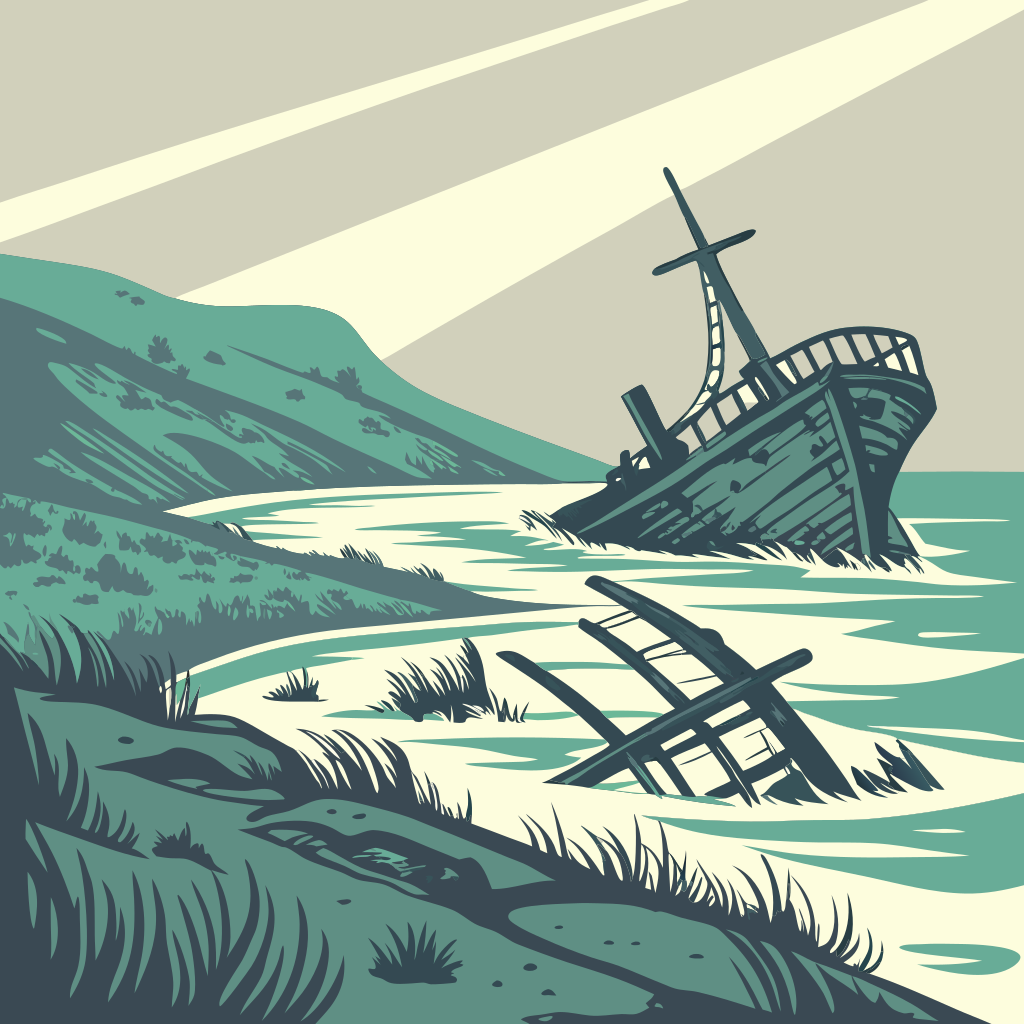
The ship began its life in August 1918 as the British War Hamlet for the Shipping Controller – W.H. Cockerline & Co. of London. A year later, in 1919, it was renamed the Newaster for the Aster Shipping Co. Ltd(E.R. Brown & Co.) of Cardiff. In 1933, it was sold to Finland and renamed Kurikka for Vaasan Laive O/Y, Wasa. The Chenango was taking over by the U.S. government from the Finnish Government. It was then turned over by the War Shipping Administration on December 27, 1941, at 10:00 AM at the port of New York. By December 30 at 12:00 PM, it was then turned over to Moore Mccormack Line under a General Agency Agreement (GAA). It was renamed the Chenango and registered in Panama.
The Chenango had left Rio de Janeiro and was headed to Baltimore via the Virgin Islands. The cargo that was on board was manganese ore. The crew was made up of 38 men. There were 14 different nationalities that made up the crew. There were Americans, Danes, Norwegians, Estonians, Swedes, Chileans, French, Portuguese, Canadians, Columbians, Belgians, Spanish, Philippianno, and Irish.
At 12:30 AM on April 21, 1942, the unescorted and unarmed was hit by a torpedo on the port side between #4 and #5 hatches. The attack came from the German U-boat U-84 commandeered by Oberleutnant zur See Horst Uphoff. The torpedo strike was so powerful that its topside personnel and loose equipment were thrown overboard. Water poured through the gaping hole in the hull. It took only two minutes for the ship to sink.
Numerous problems ensued after the explosion. First due to the sudden attack and quick sinking no distress signal was sent. Also, all but one of the lifeboats went down with the ship. The one that survived, to make matters worst, capsized. Due to the life rafts being improperly stowed on the deck, they were destroyed by the riggings above the rafts. Lucky for the only two survivors, James Bradley and Joseph Dieltiens were able to cling to the raft.
Unfortunately, the only raft that survived was one that had been condemned in New York and the only supplies on the raft were water and a fishing line. Bradley was Irish and Dieltiens was Belgian, so neither understood the other’s language. Dieltiens suffered internal injuries during the blast and was hemorrhaging internally. When help had arrived shortly after the sinking, they decided they would ration the water and any fish that they caught. Day after day passed without rescue. Coldwater continuously washed over their raft, which resulted in them being constantly wet and cold.
As they floated on the sea, over and over patrol planes would fly by without seeing their raft. They were not very successful with their fishing effort. At the same time, their water supply was diminished. Each day they grew weaker. Finally, after twelve days of floating on the Atlantic, an Army plane spotted the raft. The ship had been sunk just south of the Virginia border. However, the raft had drifted south to southeast of Oregon Inlet, North Carolina. Finally, they were discovered when the plane flew low enough for the pilot to see the two men waving frantically to call attention to their desperate situation. The pilot then called in the base and immediately a rescue plane was sent out. Captain Richard Burke flew his PH-2 seaplane and was able to land successfully on the rocking ocean. The two semi-conscious and delirious men were taken aboard the seaplane.
The men were immediately taken to the Marine Hospital a the Norfolk Naval Base. Bradley was quickly able to recover and soon was back on his feet. However, due to the severity of his internal bleeding, long-term exposure to the elements, and lack of food and water, Dieltiens died two days later.
The Chenango’s location was not known unit after the war. The Allied Command used German U-boat records which indicated successful strikes against merchant ships to pinpoint its location. In 1956, the wreck was dragged to the least depth of one hundred feet.
| Built: 1918 | Sunk: April 20, 1942 |
| Type of Vessel: Freighter | Owner: United States Maritime Commission |
| Builder: Irvine’s Ship Building and Dry Dock Co., West Hartlepool, England | Power: Coal-fired Steam |
| Port of registry: Panama | Dimensions: 342′ x 46′ x 22′ |
| Previous Names: War Hamlet, Newaster, Kurikka |
Here is the location of the sinking: 35° 25’N, 74° 55’W

Total Lost: 37, Survivors: 1
| Last | First | Date of Death | Position | Home | Age |
|---|---|---|---|---|---|
| Akesson | Johan | April 21, 1942 | Third Engineer | Spring Valley, NY | 48 |
| Arrillaga | Marcas | April 21, 1942 | Chief Cook | Spain | 45 |
| Briones | Luis | April 21, 1942 | Fireman | Chile | 45 |
| Colon | Edward | April 21, 1942 | Ordinary Seaman | New York, NY | 29 |
| Dearanjo | Francisco | April 21, 1942 | Fireman | 44 | |
| Debouge | Louis | April 21, 1942 | Able Seaman | Belguim | 39 |
| Ellingsen | Sverre Torleif | April 21, 1942 | Second Engineer Officer | Norway | 40 |
| Hereghty | Patrick | April 21, 1942 | Second Mate | Brooklyn, NY | 34 |
| Hernandez | Charles | April 21, 1942 | Oiler | Chile | 40 |
| Hollekim | Sverre Johan | April 21, 1942 | Radio Operator | Stord, Hordaland | 26 |
| Hutson | Arthur | April 21, 1942 | Able Seaman | Columbia, SC | 37 |
| Lamend | Nikolai | April 21, 1942 | Able Seaman | Estonia | 20 |
| Mauritzen | Svend | April 21, 1942 | Second Cook | West New York, NJ | 24 |
| Meireles | Antonio | April 21, 1942 | Coal Passer | Portugal | 29 |
| Milley | John | April 21, 1942 | Chief Engineer | Union, NJ | 58 |
| Mohamed | Hedad | April 21, 1942 | Fireman | France | 39 |
| Myrvold | Albert Gabriel | April 21, 1942 | Third Mate | Oslo, Norway | 46 |
| Oad | John | April 21, 1942 | Able Seaman | Estonia | 31 |
| Okeson | Emil | April 21, 1942 | Third Engineer | Sweden | 48 |
| Pederson | Holger | April 21, 1942 | Chief Mate | Norway | 30 |
| Perez | Placid F. | April 21, 1942 | First Assistant Engineer | New Orleans, LA | 50 |
| Persson | John | April 21, 1942 | Fireman | Sweden | 21 |
| Ramos | Alfred | April 21, 1942 | Coal Passer | Brooklyn, NY | 23 |
| Rasmussen | Alfred Hans | April 21, 1942 | Master/Captain | 37 | |
| Rietveld | Ferdinand | April 21, 1942 | Oiler | Belgium | 47 |
| Rodriquez | Carlos | April 21, 1942 | Ordinary Seaman | New York, NY | 19 |
| Santacruz | Antonio | April 21, 1942 | Fireman | Columbia | 47 |
| Serverius | Albert | April 21, 1942 | Messman | Belgium | 26 |
| Smith | Harry G. | April 21, 1942 | Ordinary Seaman | 42 | |
| Steinberg | Johannes | April 21, 1942 | Fireman | Estonia | 37 |
| Swiggers | Eugene | April 21, 1942 | Messman | Belgium | 35 |
| Taduran | Felomino | April 21, 1942 | Ordinary Seaman | Philippines | 28 |
| Toutant | Jean | April 21, 1942 | Fireman | Canada | 26 |
| Vercammen | Louis | April 21, 1942 | Boatswain | Belgium | 31 |
| Vilar | Julio | April 21, 1942 | Coal Passer | New York, NY | 29 |
| Walker | Roy H. | April 21, 1942 | Oiler | Canada | 21 |
A partial listing of surviving crew members.
| Last | First | Position | DOB | Home | Age |
|---|---|---|---|---|---|
| Bradley | James Terrence | Utility | 1920 | Canada | 22 |
| *Dieltins | Joseph | Chief Steward | 1900 | Belgium | 42 |
* Rescued himself with James Bradley on a raft. He was picked up 12 days after the sinking of Chenango. He died on May 4, 1942, with severe gastrointestinal hemorrhage at the U.S. Marine Hospital in Norfolk, Virginia.