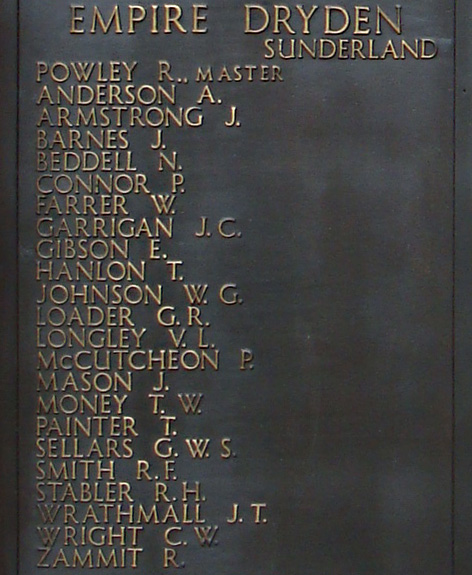
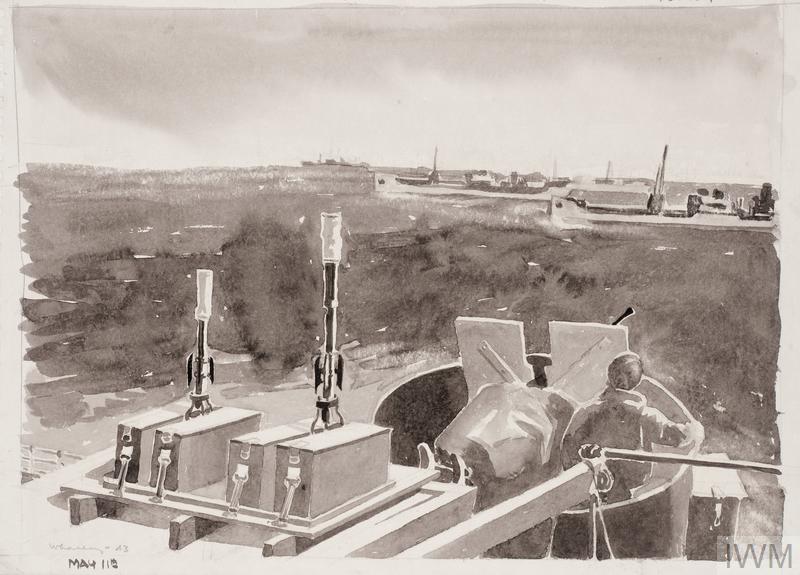
The Empire Dryden did not have a long life. The ship was completed in February of 1942. Her one and the only captain was Captain Robert Powley. The crew consisted of 51 men, all of which were from England. There were a number of teenagers aboard the ship (see listing below). Six gunners were aboard the ship. The gunners managed the four-inch gun, a 20-millimeter gun, four machine guns, an Oerlikon (a cannon), four PAC rockets, 1 Gymbal projector, and several kite rockets.
The Empire Dryden began her first voyage on February 27, 1942, when she left Sunderland and joined Convoy FN 642. They were heading to Methil, Fife, Scotland. Once there she joined Convoy EN 53 and arrived in Oban, Scotland on March 4. Then it was on to Loch Ewe and Liverpool without cargo on board. Five days later (March 9), she sailed from Liverpool in Convoy ON 74 and arrived in Halifax, Nova Scotia on March 25. That convoy consisted of 47 merchant ships and 10 escorts.
The Empire Dryden left Halifax and headed to Boston between March 27 and March 29 with Convoy XB 5. She then ventured south, solo through the Cape Cod Canal headed to New York. She arrived in New York on April 1, 1942. There at the New York Harbor, the ship was loaded with 7,100 tons of cargo that included grain and military stores that included explosives that were to be used by Allied forces against Rommel’s army in North Africa. The voyage was to be from Cape Town to Alexandria via the Red Sea and Suez Canal.
So this new ship was set for her first big voyage that would take her east of Bermuda. She set sail at 5:30 PM on April 17, 1942. Early on April 19, about 350 miles southeast of New York and halfway to Bermuda, the Empire Dryden discovered a lifeboat with 21 survivors from a torpedoed and damaged Argentinian ship, Victoria. It had been attacked the day before by the German U-boat U-201. Those in the lifeboat had fled their ship concerned about its possibly sinking. However, the ship stayed afloat and was able to sail to New York arriving on April 21.
Just as the men aboard the Empire Dryden were set to rescue the men on the lifeboat, a lookout spotted the USS Owl (AM 2), a US Navy tugboat towing a barge to Bermuda. The Owl took the men instead. Now aware of the danger of U-boats in the area, the crew continued their voyage south with extreme caution.
On January 19 at 4 PM the Naval Control in Ottawa, Canada gave new orders for the ship to sail west, instead of east, of Bermuda. The radio operators aboard received the orders and took approximately an hour to decode the message. So around 5 PM, their course was altered to 30° to starboard, to south-southwest. By 8:55 PM it was located about 450 miles east of Cape Hatteras. At that time she was traveling at about 10.5 knots and because it was night was traveling in blacked-out condition. They were maintaining radio silence since leaving New York except to receive the plans to change course.
On April 19, the Empire Dryden saw a lifeboat from the Victoria, which had been torpedoed by U-201 on April. Instead of stopping to pick them up, they signaled the USS Owl (AM 2) of their location and continued on their way.
The weather at the time was good and visibility was just as good. Chief Officer Rixham reported that the Empire Dryden was maintaining a steady course. However, the German U-boat that had been observing her since sunset (around 6:30 PM) reported her on a zig-zagging course. At that time there were four lookouts: one in the crow’s nest, two on the gun platform at the stern, and either one or two officers on the bridge. To their knowledge, there were no submarines that they could see. However, as mentioned previously, the German U-boat, U-572 under the command of Kapitänletnant Heinz Hirsacker had the Empire Dryden in their sights.
According to the German U-boat’s logs the following describes what happened:
| Built: 1942 | Sunk: April 20, 1942 |
| Type of Vessel: Steam Merchant | Owner: Sir R. Ropner & Co. Ltd, SWest hartlepool |
| Builder: Wm. Doxford & Sons Ltd., Sunderland | Power: Coal – Single Screw |
| Port of registry: Sunderland | Dimensions: 443′ x 56.4′ x 35.4′ |
| Previous Names: |
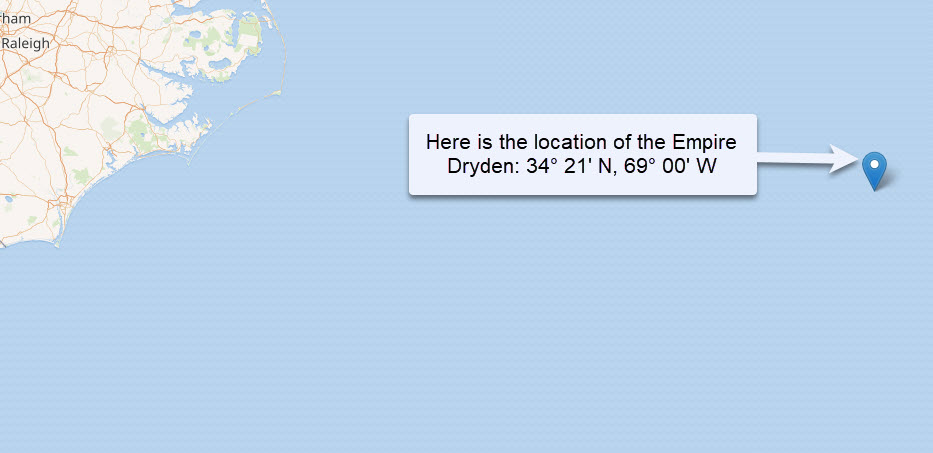
Here is the location of the sinking: 34° 21’N, 69° 00’W
Total Lost: 26, Survivors: 25
| Last | First | Date of Death | Position | Home | Age |
|---|---|---|---|---|---|
| Anderson | Angus | April 20, 1942 | Cook | Stirling | 41 |
| Armstrong | Joseph | April 20, 1942 | Fireman/Trimmer | Hendon, Sunderland Co., Durham | 22 |
| Barnes | James | April 20, 1942 | Third Engineer Officer | Oldham | 25 |
| Beddell | Norman | April 20, 1942 | Fireman/Trimmer | Ryhope | 27 |
| Brooks | Dennis | April 20, 1942 | Able Seaman/DEMS Gunner | Hackney, London | 20 |
| Brown | John Raymond | April 20, 1942 | Able Seaman/DEMS Gunner | Consett, Co., Durham | 19 |
| Connor | Patrick | April 20, 1942 | Steward’s Boy | Sunderland, Co., Durham | 18 |
| Farrer | Walter | April 20, 1942 | Fireman/Trimmer | Sunderland, Co., Durham | 25 |
| Garrigan | John Colin | April 20, 1942 | Galley Boy | Houghton-le-Spring, Co., Durham | 19 |
| Gibson | Ernest | April 20, 1942 | Able Seaman | Sunderland, Co., Durham | 35 |
| Hanlon | Thomas | April 20, 1942 | Sailor | Washington, Co., Durham | 19 |
| Johnson | William George | April 20, 1942 | Donkeyman and Greaser | Sunderland, Co., Durham | 41 |
| Loader | George Richard | April 20, 1942 | Fireman/Trimmer | Jarrow, Co., Durham | 22 |
| Longley | Victor Leonard | April 20, 1942 | Third Radio Officer | Edgware, Middlesex | 19 |
| Mason | John | April 20, 1942 | Sailor | Sunderland, Co., Durham | 19 |
| McCutcheon | Patrick | April 20, 1942 | Fireman/Trimmer | Belfast | 50 |
| Money | Thomas William | April 20, 1942 | Third Officer | Newcastle-upon-Tyne | 26 |
| Painter | Thomas | April 20, 1942 | Able Seaman | Coxhoe, Co., Durham | 32 |
| Powley | Robert | April 20, 1942 | Master/Captain | Sunderland, Co., Durham | 35 |
| Sellars | George Waite Steel | April 20, 1942 | Able Seaman | Sunderland, Co., Durham | 52 |
| Smith | Ralph Frederick | April 20, 1942 | Fireman/Trimmer | Tynemouth, North Shields, Northumberland | 24 |
| Snary | John Edward | April 20, 1942 | DEMS Gunner | Tottenham, Middlesex | 30 |
| Stabler | Ralph Huggup | April 20, 1942 | Second Engineer Officer | 26 | |
| Wrathmall | John Thomas | April 20, 1942 | Sailor | Sunderland, Co., Durham | 21 |
| Wright | Charles William | April 20, 1942 | Fireman/Trimmer | West Hartlepool, Co., Durham | 25 |
| Zammit | Raymond | April 20, 1942 | Chief Steward | Sunderland, Co., Durham | 44 |
A partial listing of surviving crew members.
| Last | First | Position | DOB | Home | Age |
|---|---|---|---|---|---|
| Donneky | David Henry | Able Seaman | |||
| Downes | Harold Wilson | Fourth Engineer Officer | Feb. 10, 1920 | Sunderland, Co., Durham | 22 |
| Dutton | James Charkley | Assistant Steward | |||
| Hall | Leslie | Cook | Sept. 10, 1923 | Sunderland, Co., Durham | 18 |
| Rixham | Christopher Thomas Valentine | Chief Officer | |||
| Saunders | Norman | Boatswain | |||
| Swinburn | James | Fireman/Trimmer | |||
| *Urwin | John | Chief Engineer Officer | Dec. 26, 1881 | Ouston, Co., Durham | 60 |
| Whittet | David Scott | Second Officer | 1917 | 25 |
*Survived the sinking of the Rushpool on January 30, 1941, by German U-boat, U-94. Also, survived the sinking of the Roxby on November 7, 1942, by the German U-boat, U-613.