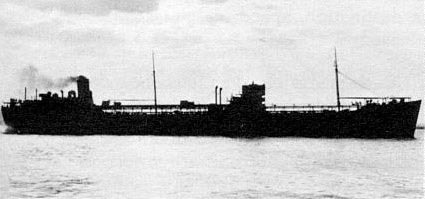
As German U-boat attacks along the coast became more frequent, ships were assigned a U.S. Navy gun crew. On March 10, 1942 the John D. Gill had been ordered into the port of Charleston, S.C. due to recent U-boat sightings off the coast.
The Gill was hauling gasoline and Texas crude oil that was to be processed at a refinery in Philadelphia. While coming north from the Gulf of Mexico, the ship spotted shadows on its way north to Philadelphia. The navy officials then ordered the shi into the nearest port, which happened to be Charleston, S.C.
This was only the second voyage of the John D. Gill that was built in 1941. The name of the ship came from one of the Atlantic Refining Company executives.
On her maiden voyage, two weeks prior (Feb. 27), the crew had rescued two lifeboats of crew members from the Maroe, after it was sunk by a German U-boat.
On the night of March 12, 1942, a hazy sky made visibility drop down below a mile. The seas were calm. The John D. Gill proceeded north following a zig-zag approach up the coast towards Philadelphia.
Ships had learned to take a zig-zag approach as they navigated the waters of the Atlantic to make it more difficult for the German U-boats to attack.
At the time of the attack 11 of the 49 men were on active duty. The other crew members were either sleeping or involved in other activities.
While the men rested, the captain of the German U-boat, U-158, Erich Rostin was zeroing in on its target. The captain having already been successful in sinking the Caribsea and the Rostin, was very familiar with the treacherous waters off the coast. Cape Fear extended out into the Atlantic, the Frying Pan Shoals was located 28 miles past Bald Head Island. The Shoals were known to be treacherous due to the strong currents and shallow waters.
Captain Rostin knew that the ship would avoid these treacherous waters. He also believed the John D. Gill’s captain, Master Allen Tucker, would be so focused on navigating these waters that it was the perfect opportunity to attack.
Since the beginning of 1942, the number of attacks had rapidly increased and all the ships traveling north, in particular, were a bit on edge.
At 10:10 P.M., the U-boat launched its torpedoes. No one saw it coming as it struck the starboard side at the #7 tank and exploded at the mainmast. Men were thrown from their beds or knocked to their knees as the blast struck the ship.
The ship immediately began to list, as black crude oil poured out of the ruptured plating amidship. The captain gave the orders to abandon ship. While men scrambled to find life preservers and boat stations, a distress message was sent out alerting the authorities of the attack.
The men knew the drill and began to put on the life jackets and prepare the lifeboats for release over the edge of the ship. Unfortunately, things went from bad to worst.
At the time, some life jackets were equipped with a carbide flare. This flare would ignite once it was submersed in water. The thought being the flare would alert rescuers to the whereabouts of a man, making it easier to track them.
Once that flare ignited, tragedy struck. The waters around the John D. Gill was filled with oil and gasoline. The flare created a huge blaze that overwhelmed the entire ship and lite up the night sky.
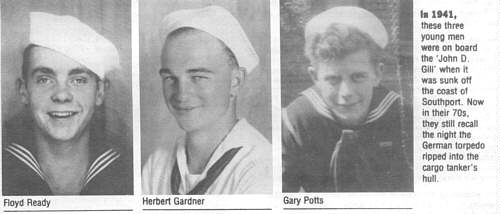
One of the Navy seaman, Gary Potts, was asleep at the time of the attack. He immediately jumped up and headed to the deck to man the 5-51 breech loading cannon that was located on the starboard side. The other seamen joined him in manning their post in search of the U-boat, which nowhere to be found. As they swept the gun back and forth, boats were being unloaded and men were jumping overboard.
The heat was so intense that it singed the hair on the Navy crewmen’s heads and arms. The metal gun tube became so hot that it was untouchable for fear of getting burned. With all of this said, the gun crew remained at their post. The Ensign in charge, Robert Hutchins, finally ordered the crew to abandon ship, after he noticed the paint on the ammunition box begin to pucker. He stated, “The flames got on top of us and we jumped over the side,” when he told this story 50 years later. “I saw two of my boys go into the flames and I heard them scream as they died.”
Chaos ensued as one lifeboat capsized as it was being lowered. Two men fell from the boat and were killed when they hit the brass screws that were still operational on the stern of the ship.
One seaman, Herbert Gardner, relived his story of survival. At the time of the explosion, a mess boy along with him, attempted to overturn the capsized life boat. During their effort the mess boy lost his grip and fell into the water and was never seen again. Meanwhile, Gardner continued to attempt to right the lifeboat. He was finally too weak and he jumped into the flame-covered sea. He was fortunate enough to have landed in an area that wasn’t covered in flames. When he surfaced he noticed a friend not to far away. Unfortunately, the man was in such a state of panic, his friend warned him to stay away. The friend had a life jacket on, while Gardner had none. It appeared to be a “every man for himself” moment. There was no choice, he had to find another way to survive. By this time, flames began to encircle him. He had two choices, either get consumed by the flames or dive beneath the burning oil and swim towards clear waters. Gardner’s hair caught fire, and while holding his breath, and swim for his life. He successfully made it and was able to climb aboard a raft.
He was finally free of the flames. The salt water began to sting his burnt skin and the pain began to overcome the adrenalin rush he had felt previously.
The men he shared the raft with were covered in oil. Moans could be heard from the exhausted and injured men. At the same time, men recalled of the harrowing stories about men who had survived previous sinkings only to find their end when German U-boats would machine gun them down while they awaited rescue in their lifeboats.
Meanwhile, on the Oak Island beach could be seen the glow of the burning John D. Gill. Men from the lifesaving station launched their Motor Lifeboat 4405 and head towards the burning ship. The U.S. Coast Guard Cutte Agassiz, Coast Guard Cutter 186, and the Navy tugboat, Umpqua, joined in on the rescue.
At dawn, a flare drew rescuers to a life raft holding eleven burnt and exhausted men. Later in the day, the tanker Robert H. Colley found the remaining lifeboat and took aboard fifteen survivors. No other survivors were found.
As the explosion occurred, the people of Southport began to prepare for the survivors. Nurse Josephine Hickman and other members of the Red Cross volunteers prepared the Arthur J. Dosher Memorial Hospital to receive the wounded men.
When CGC 186 arrived at Southport with the first eleven men, they were their to assist in the rescue effort.
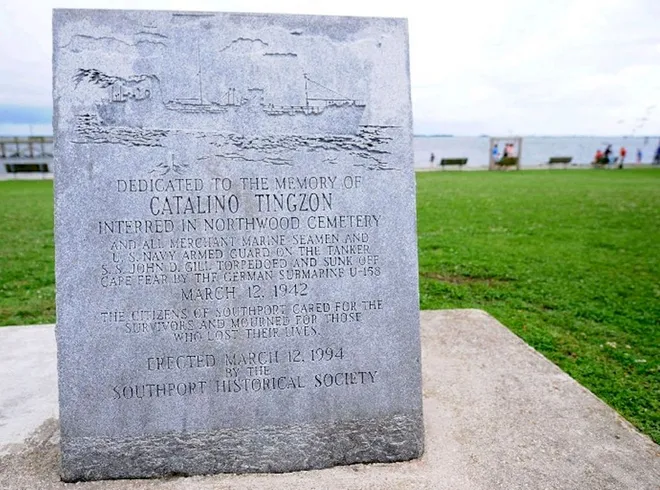
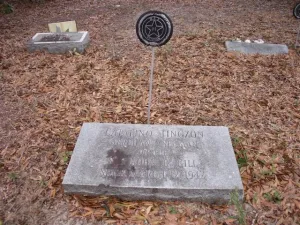
One of the men brought to Southport was messman, Catalino Tingzon, who died when he fell out of a lifeboat and couldn’t be rescued. A search of the Philippines, were he was from, could not find any family members to report the tragic news. The people of Southport then adopted him and buried him in a local commentary.
At nine o’clock the following morning, March 13, 1942, the John D. Gill was to be seen no more. It fell below the surface and ended a tragic night brought on by the attack from the German U-boat, U-158. As fate would have it a few months later (June 30, 1942) , the U-158 would be hit by a depth charge dropped by the U.S. Navy aircraft, PBM Mariner flying boat from squadron VP-74. The U-boat immediately sunk and all 54 members of the crew perished.
| Built: 1941 | Sunk: March 12, 1942 |
| Type of Vessel: Tanker | Owner: Atlantic Refining Company |
| Builder: Sun Ship & Drydock Co, Chester, PA | Power: Oil-fired steam turbine connected to electric motor and shaft |
| Port of registry: Philadelphia, PA | Dimensions: 528′ x 70′ x 39′ |
| Previous Names: | Lost Crew: 23 |
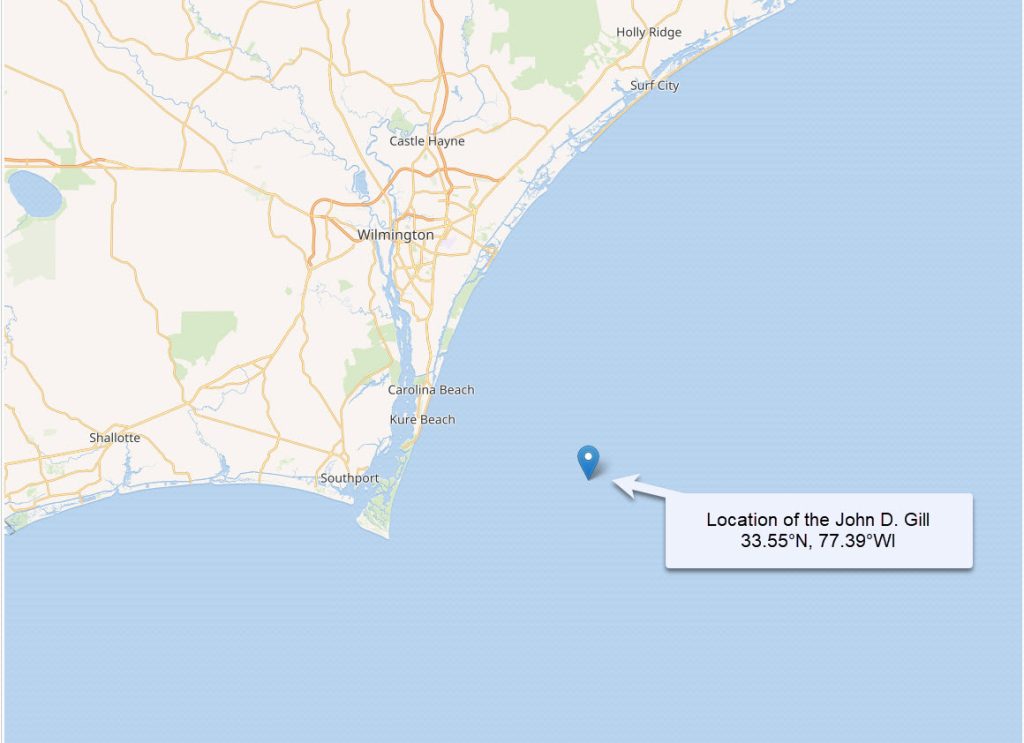
Here is the location of the sinking: 33.55°N, 77.39°W
A partial listing of the lost crew: Total Crew Lost: 23, Survivors: 26
Last Name | First Name | Date | Position | Home | Age |
|---|---|---|---|---|---|
| Atherholt | William | 3/12/1942 | Oiler | Glenolden, PA | Unknown |
| Avestruz | Felimon | 3/12/1942 | Messman | Brooklyn NY | Unknown |
| Carreon | Benjamin | 3/12/1942 | Messman | Octon PI | Unknown |
| Cristobal | Federico Curpos | 3/12/1942 | Galleyman | Philadelphia PA | Unknown |
| Demichael | Anthony | 3/12/1942 | O.S. | Lansford PA | Unknown |
| Eckman | Alan Merritt Thorpe | 3/12/1942 | Chief Mate | Glenside PA | Unknown |
| Flores | Sixto Degollado | 3/12/1942 | Steward | Philadelphia PA | Unknown |
| Gaskins | Harry Russell | 3/12/1942 | 3rd Engineer | Kilmarnock VA | Unknown |
| Geier | William Joseph Jr. | 3/12/1942 | Deck Maint. | South Boston MA | Unknown |
| Gurtov | Robert | 3/12/1942 | Bosun | Philadelphia PA | Unknown |
| Hagerty | Joseph | 3/12/1942 | 3rd Mate | Atlantic City NJ | Unknown |
| Jiminez | Henry Anthony | 3/12/1942 | F/W | Philadelphia PA | Unknown |
| Kimball | Charles Percy | 3/12/1942 | 2nd Mate | Port Huron MI | Unknown |
| Leffler | Jacob | 3/12/1942 | Oiler | Philadelphia PA | Unknown |
| Lewis | Vincent Harold | 3/12/1942 | Pumpman | Jackson MS | Unknown |
| Rappaport | David Walter | 3/12/1942 | 1st Engineer | Philadelphia PA | Unknown |
| Scasni | Paul | 3/12/1942 | Deck Maint. | Lansford PA | Unknown |
| Sitnick | Israel | 3/12/1942 | 2nd Engineer | Philadelphia PA | Unknown |
| Tingzon | Catalino | 3/12/1942 | Messman | Philadelphia PA | Unknown |
A partial listing of surviving members.
| Last | First | Position | DOB | Home | Age |
| Cheney, Jr. | Edwin F. | Quater Master | |||
| Gardner | Herbert | Navy Crewman | |||
| Putts | Gary | Navy Crewman | |||
| Ready | Floyd | Navy Crewman | |||
| Tucker | Allen | Captain | 3/24/1885 | Port Arthur, TX | 57 |